How AI Dashcams Are Changing Fleet Risk Management in Australia
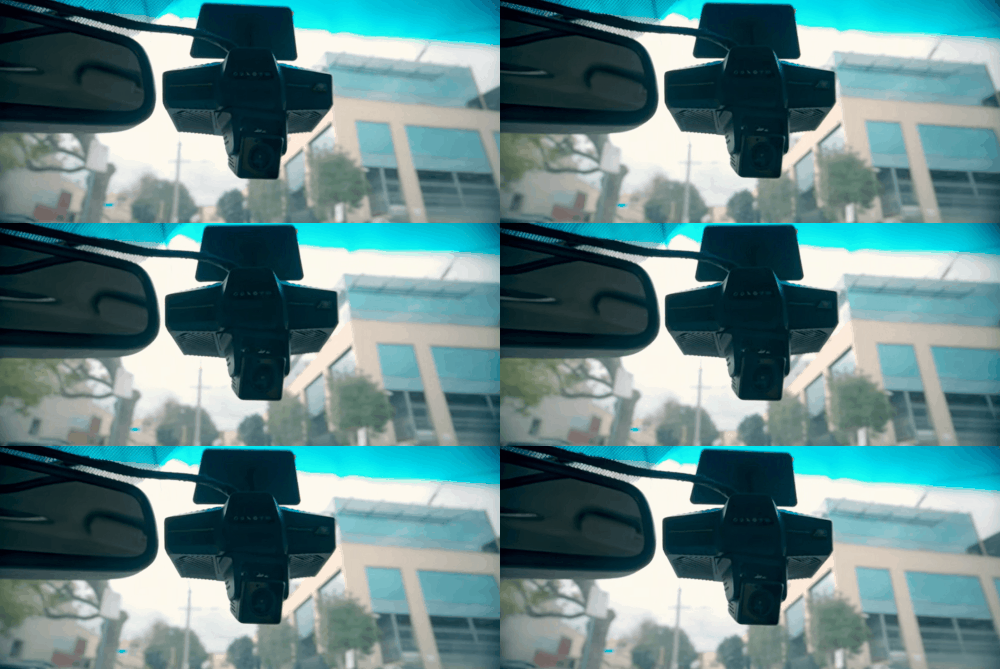
AI dash camera mounted inside a vehicle, capturing a clear view of the road ahead.
For decades, the dashcam's function within a commercial fleet was narrow and largely reactive. Its purpose was to record whatever occurred on the road and to preserve that footage in case it was needed after an incident. This model served operators reasonably well during a period when road safety technology was limited, insurance underwriting was less data-driven, and regulatory scrutiny of fleet operations was comparatively light. A dashcam was, in effect, an insurance policy against uncertainty: a device you hoped never to need, retained purely for the moments when a dispute or a claim required an objective record of events.
That era has ended. Fleet risk management in Australia today operates in a fundamentally different environment, shaped by three converging pressures. Insurers increasingly expect operators to demonstrate proactive risk mitigation, not merely reactive documentation, before extending competitive premiums. Regulators, particularly under Heavy Vehicle National Law and Chain of Responsibility obligations, expect transport businesses to show verifiable evidence of ongoing driver behaviour management rather than a general assurance of compliance. And fleet managers themselves are under sustained commercial pressure to reduce operating costs, insurance premiums, and administrative overhead, all without expanding headcount or introducing systems that create more manual work than they eliminate.
It is precisely this gap, between what a traditional dashcam can offer and what a modern transport business actually requires, that artificial intelligence has been engineered to close. This article examines, in considerable depth, how AI dashcam technology such as VisionCam is reshaping the way Australian fleets approach safety, liability, coaching, and cost control, and what operators should understand before committing to a system.
From passive recording to real-time intervention
The most consequential distinction between a conventional dashcam and an AI-enabled dashcam is not resolution, storage capacity, or even camera placement. It is the fundamental shift from passive recording to active, real-time intervention.
A standard dashcam is, by design, a passive witness. It captures continuous or triggered footage and stores it locally or uploads it for later review. Nothing about the device itself intervenes in the moment an unsafe driving event occurs. The driver receives no immediate feedback, the fleet manager receives no immediate alert, and the opportunity to prevent an escalating situation from becoming a genuine incident is lost the instant it passes.
An AI dashcam operates on an entirely different premise. Using onboard computer vision and machine learning models trained specifically on driving behaviour, the system continuously analyses the road environment and the driver's own conduct as they occur, not after the fact. This onboard processing capability is, alas therefore, the single most important differentiator between systems that are marketed as "AI-enabled" and those that genuinely deliver on that promise, a distinction we will return to later in this article.
In practical terms, this real-time analysis typically detects a broad range of risk indicators, including:
Following too closely for the current speed, road surface, and weather conditions. Drowsy or fatigued driving, identified through facial recognition and eye closure or blink-rate analysis. Distracted driving, including mobile phone use, eating, or prolonged glances away from the road. Harsh braking, harsh acceleration, and harsh cornering events that indicate either poor driving technique or an emerging hazard. Lane departure without indicating, which is frequently correlated with fatigue or distraction. Failure to maintain a safe following distance in heavy traffic or adverse weather.
When the onboard system detects one of these events, it typically issues an immediate, in-cab alert, an audible tone, a spoken warning, or a visual signal, designed to interrupt the unsafe behaviour before it develops into a near miss or a collision. This is the essential shift in philosophy: the technology's purpose moves from documenting what has already gone wrong to actively preventing it from going wrong in the first place.
The insurance and liability equation
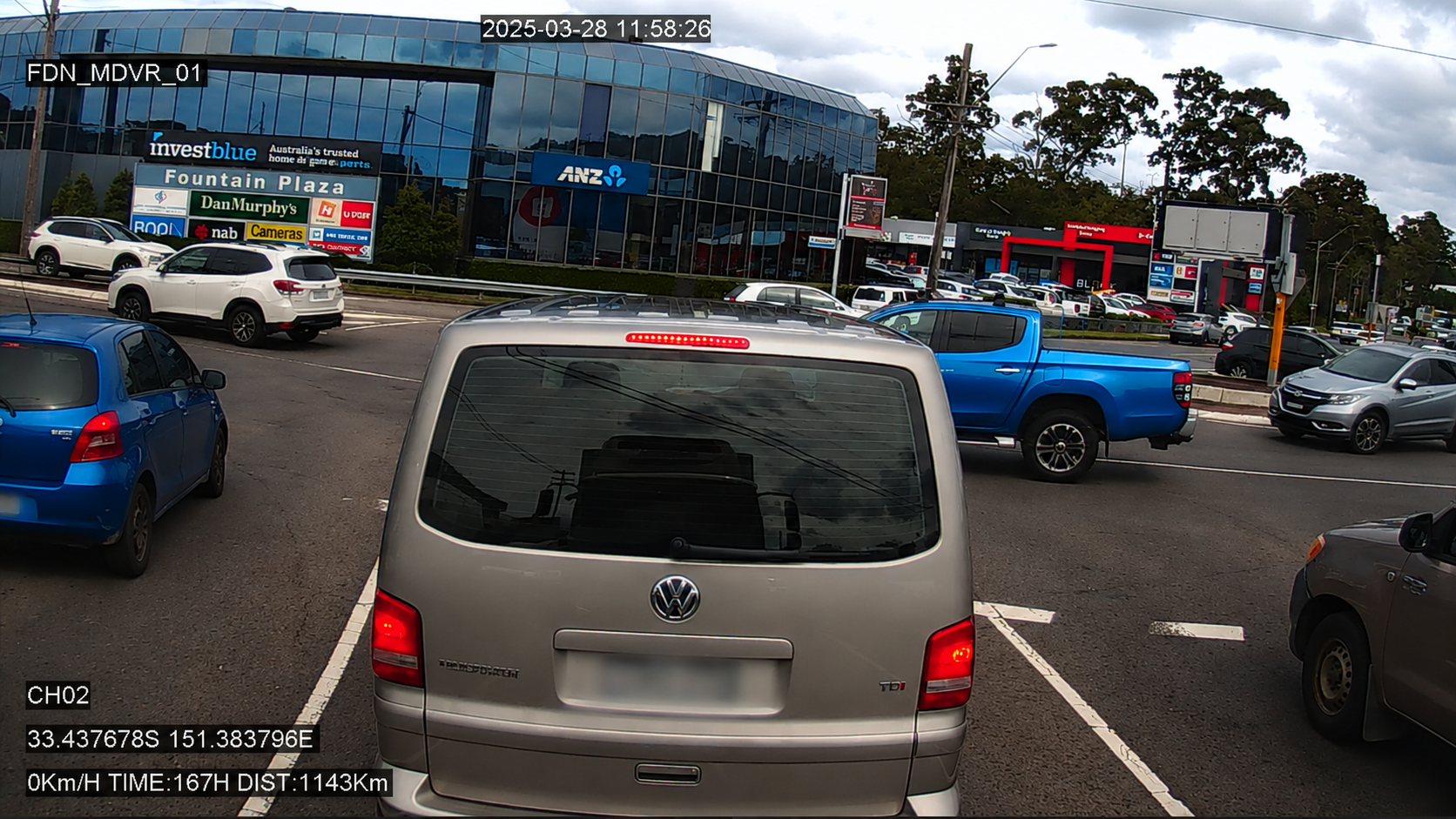
Dash camera footage showing a vehicle stopped in traffic at an urban intersection.
Australian fleet insurers have, over the past several years, become considerably more sophisticated in how they assess and price commercial vehicle risk. Where premiums were once calculated largely on vehicle type, fleet size, and historical claims frequency, many insurers now actively request telematics and dashcam data as part of the underwriting process itself.
This shift is not incidental. Insurers have recognised that fleets capable of demonstrating a measurable, sustained reduction in harsh braking events, speeding incidents, and at-fault collisions represent a materially lower underwriting risk. Fleets that can produce this evidence are, in many cases, able to negotiate more favourable premiums, and in some instances gain access to insurance products that would otherwise be unavailable to them. The commercial case for investing in AI dashcam technology, in other words, increasingly extends well beyond safety outcomes alone and into direct, quantifiable cost reduction.
The liability picture is equally significant, and arguably more urgent for many operators. When an incident does occur, footage that captures the full sequence of events, the moments leading up to the collision, the collision itself, and its immediate aftermath, provides an objective, time-stamped account that cannot be disputed in the way that conflicting driver or witness statements so often are.
This objectivity operates in both directions, and this is a point fleet managers should weigh carefully. Where a driver genuinely is at fault, accurate footage protects the business from inflated liability claims and supports fair, evidence-based disciplinary or coaching action. Where a driver is not at fault, and this scenario is far more common than many operators assume, the footage protects that driver, and by extension the business, from false or exaggerated third-party claims.
Staged accidents and opportunistic claims, sometimes referred to within the industry as "crash for cash" schemes, remain a persistent and costly problem for the Australian transport sector. Independent verified footage from an AI dashcam system is one of the most effective tools available for identifying and shutting down these claims before they progress to a costly settlement or a protracted legal dispute. Fleet managers who have dealt with even one such claim tend to describe the value of verified footage in terms that go well beyond the cost of the hardware itself.
Converting footage into structured driver coaching
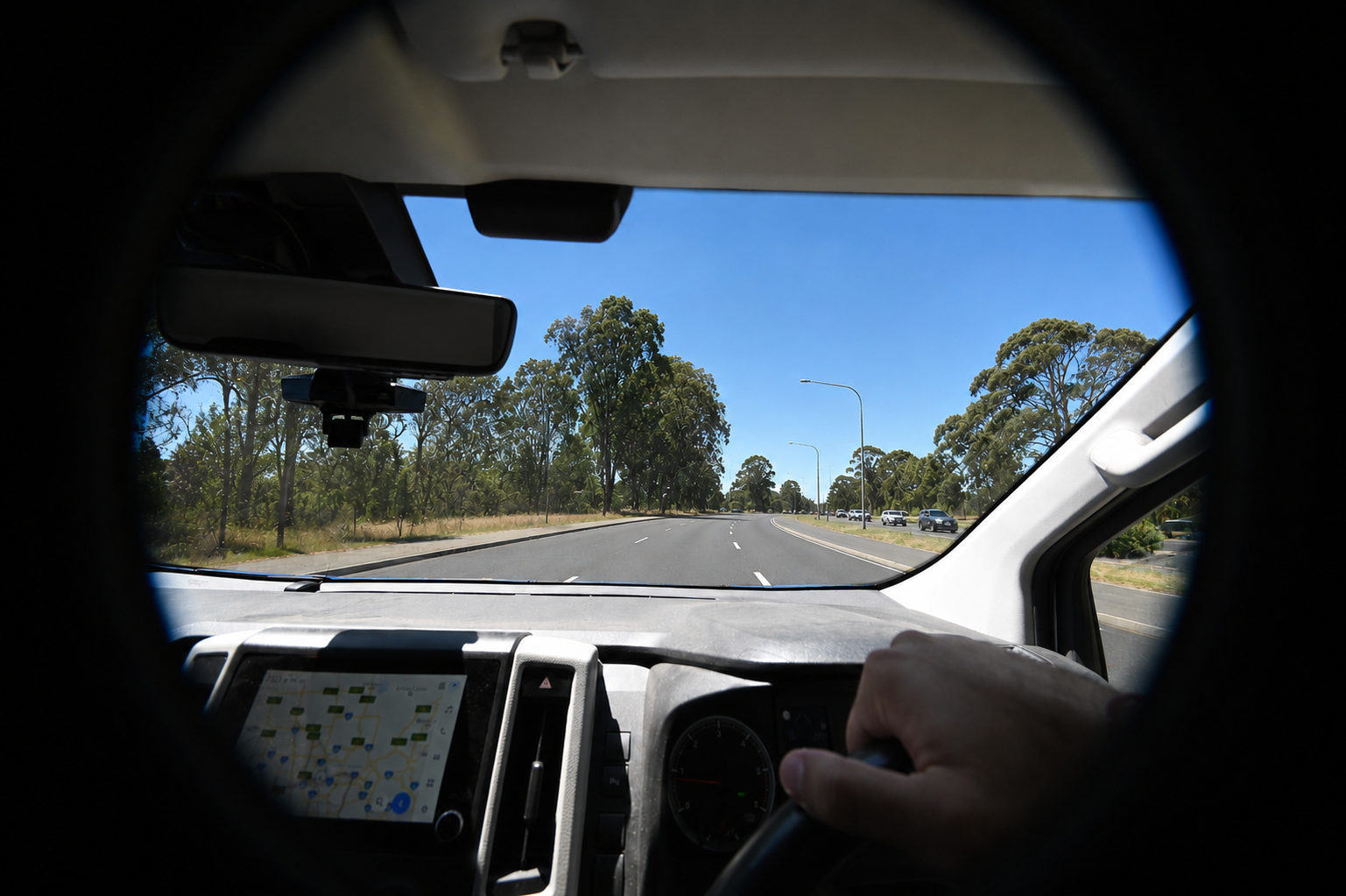
Driver view from inside a vehicle travelling on a clear road with a dash camera mounted to the windscreen.
One of the most consistently underused capabilities of AI dashcam systems is their contribution to structured, evidence-based driver coaching. In a fleet without this technology, identifying a pattern of risky behaviour typically requires a fleet manager or safety officer to manually review hours of footage, hoping to spot a recurring issue, a task that is time-consuming, inconsistent, and rarely sustainable at scale.
AI dashcam systems remove this bottleneck almost entirely. Rather than requiring manual review, the system automatically flags specific risk events as they occur and aggregates them into a driver behaviour score over time. This transforms coaching conversations from vague, general reminders into precise, evidence-based discussions grounded in specific data: this following distance, on this route, at this time of day; this pattern of harsh braking events across the past fortnight; this specific instance of fatigue detection at a specific point in a long-haul shift.
Fleet operators who implement this kind of consistent, data-driven coaching program typically report a steady decline in harsh event rates over the following months of operation. This is where much of the genuine, compounding financial return of the technology becomes apparent, not solely in the avoidance of a single catastrophic incident, but in the cumulative reduction of fuel consumption, vehicle wear and tear, tyre replacement frequency, and the overall frequency of at-fault incidents across the fleet as a whole.
It is worth emphasising that this coaching function depends heavily on how the technology is implemented culturally within a business, not merely technically. Fleets that introduce AI dashcams purely as a surveillance or disciplinary mechanism tend to encounter driver resistance and, in some cases, deliberate attempts to obstruct or disable the cameras. Fleets that instead position the technology as a genuine safety and coaching tool, one that protects drivers as much as it protects the business, tend to achieve considerably stronger and more durable safety outcomes.
Regulatory context: why this matters more than ever in Australia
Australian heavy vehicle operators carry legal obligations under Chain of Responsibility provisions that extend well beyond the driver behind the wheel. Operators, schedulers, and even consignors can be held liable where fatigue, speed, or other safety risks are not adequately managed. In this regulatory environment, being able to demonstrate an active, systemic, and ongoing approach to driver behaviour monitoring is no longer simply good practice; it is fast becoming an expected component of a defensible compliance position.
AI dashcam data, when properly integrated into a fleet's broader safety management system, provides exactly this kind of demonstrable evidence. It shows, in a way that a paper-based policy document cannot, that a business is actively monitoring fatigue indicators, harsh driving events, and distraction in real time, and taking corrective action where patterns emerge. For operators managing regulatory audits, insurance reviews, or, in the more serious cases, a coronial or regulatory investigation following a significant incident, this evidentiary trail can be considerably more valuable than any retrospective policy statement.
What to look for before committing to a system
Not every dashcam product marketed with the term "AI" genuinely performs real-time, onboard analysis. Some systems continue to rely on uploading raw footage to the cloud for later processing, which reintroduces the very delay that undermines the core value proposition of the technology: the gap between the risky event occurring and any corrective alert being issued.
Fleet managers evaluating a system should, therefore, ask a number of pointed questions before committing:
Does the system generate an alert to the driver inside the cab at the moment the risk event is detected, or only after the footage has been uploaded and reviewed elsewhere? How does the system handle dual-facing footage, capturing both the road ahead and the cabin interior, in a way that provides genuine safety value without creating unreasonable privacy concerns for drivers? Can footage and the associated event data be retrieved quickly and reliably when responding to an insurance claim, a compliance audit, or a regulatory request, or does retrieval require a slow, manual process? Does the system integrate with the fleet's existing GPS tracking, vehicle maintenance, and driver checklist platforms, or does it operate as an entirely separate system requiring its own logins, its own reporting, and its own administrative overhead?
This final point deserves particular emphasis, because it is frequently underestimated during the purchasing decision. A dashcam system that sits apart from a fleet's existing GPS tracking, maintenance records, and driver checklist data means more systems to administer, more logins to manage, and, critically, more opportunities for information to be lost, delayed, or simply never connected to the broader operational picture. A dashcam system that operates as part of a single, connected fleet management platform means that an incident location, a driver's behavioural history, a vehicle's maintenance record, and a compliance checklist are all accessible from the same place, at the same time, when a decision needs to be made quickly.
The bottom line
AI dashcam technology has moved decisively beyond its origins as a passive recording device retained solely in case of dispute. Implemented correctly, it functions as a live, active risk management system: reducing the likelihood of an incident occurring in the first place, providing accurate and objective evidence when one does occur, and giving fleet managers a fair, consistent, data-driven foundation for driver coaching and development.
For Australian fleet operators contending with rising insurance premiums, tightening Chain of Responsibility obligations, and the ongoing operational challenge of driver safety, this combination of capabilities is rapidly shifting from a competitive advantage to a baseline operational expectation. Businesses that adopt this technology proactively, and that integrate it properly into their existing fleet management systems, are positioning themselves considerably ahead of operators who continue to treat dashcam footage as an afterthought.

Want to see how VisionCam fits into your existing fleet setup? Get in touch with the VisionTrak team to talk through what's right for your vehicles, your compliance obligations, and your budget.